


美姐
Restoration brings endangered egrets to China’s Yellow Sea coast_我的网站

A |

At 5 am, Wang Piyu, deputy director of the Changhai County Natural Resources Affairs Service Center, sets out by patrol boat for Fantuozi Island, a core breeding site for Chinese egrets in the Changshan Archipelago, Northeast China's Liaoning Province. The island has no permanent residents.
About 100 meters from the island, Wang turns off the engine and reminds accompanying researchers to keep their voices low to avoid disturbing the nesting birds.
Stepping onto the island, they walk along paths covered with vines. Scattered across the rocky slopes are nests measuring 40 to 50 centimeters in diameter. Inside, fluffy chicks huddle together among soft grass woven into nests, while adult birds perch high in the trees, watching cautiously.
"This was not what the island looked like 10 years ago," Wang recalled. "People used to collect eggs here, and coastal aquaculture polluted the tidal flats. Many parts of the island were bare, leaving little vegetation for birds to nest."
The recovery of Changshan Archipelago, however, has turned the remote archipelago into an important link in global conservation efforts.
At the 48th session of the UNESCO World Heritage Committee in Busan, South Korea, the boundary modification of the Migratory Bird Sanctuaries along the Coast of Yellow Sea-Bohai Gulf of China was approved, officially adding the Changshan Archipelago to the World Heritage site.
The expansion further strengthens the integrity of the serial natural heritage site, following a previous update in 2024, and highlights China's efforts to integrate coastal ecosystem conservation, according to the National Forestry and Grassland Administration.
Behind the World Heritage recognition lies years of conservation work involving local authorities and island residents.

Located in the northern Yellow Sea off Dalian, the Changshan Archipelago sits along a key route of the East Asian-Australasian Flyway, providing an essential stopover where tens of millions of migratory birds replenish their energy during their journeys across the Bohai Sea.
The newly added area covers more than 4,900 hectares and is home to more than 140 recorded bird species, including the Chinese egret and black-faced spoonbill, both listed as China's national first-class protected animals.
In 2015, more than 300 Chinese egrets arrived in Changhai county. After discovering the birds, local authorities introduced a series of protective measures, including establishing patrol teams and installing remote monitoring systems to reduce human disturbance.
However, the growing bird population also created new challenges.
Less than half of Fantuozi Island was covered by shrubs, which serve as the nesting grounds for the egrets. Additionally, the island's poor soil and acidification caused by years of accumulated bird droppings had led to the withering and death of some shrubs in recent years.
From 2022, the county launched an ecological restoration project, replacing surface soil with fertile earth and planting more than 2,200 shrubs.
The efforts helped restore the breeding habitat. The number of Chinese egrets on the island has since recovered, with this year's population estimated at about 3,500, including around 1,500 adults and nearly 2,000 chicks, according to Lü Yongquan, director of Changhai county's natural resources bureau.
"Chinese egrets are highly sensitive to water quality, vegetation and human disturbance. Their return to breed here is a sign that the marine ecosystem has recovered and is thriving," Lü told the Global Times.
From fishermen to guardians
Conservation in Changhai is not only carried out by authorities. Local communities have also gradually become part of the protection network.
Authorities have expanded public awareness campaigns and strengthened patrols. Because most of the Changshan Archipelago is uninhabited, drones, fixed-point infrared cameras, and on-site inspections are used to monitor the islands and reefs around the clock.
Many fishermen who once relied on the sea for their livelihoods now help protect it.
During the peak breeding season from April to July, regular marine patrols are carried out to protect nesting sites and prevent illegal egg collection and habitat damage. Local bird conservation groups and research institutions have also joined the efforts, while fishermen have taken on new roles as volunteer guardians of the islands.
Across Changhai county, many fishermen now actively participate in coastal patrols to help protect the archipelago's biodiversity.
For Li Qingsen, a 50-year-old island native and member of the county's forest fire brigade, protecting the birds has become a way of life.
From spring to autumn, 20 team members take turns staying on Fantuozi Island in pairs to protect the birds from disturbance.
Life on the 0.08-square-kilometer island is far from easy. There are no freshwater sources or docks. Patrol workers carry large barrels of water and wade ashore from boats anchored offshore. Instant noodles are often their main food because they require little preparation and some water.
Their work is closely tied to the seasonal cycle of the birds. Each April, thousands of Chinese egrets arrive in the archipelago from Southeast Asia to breed and rear their young, staying until early September before migrating south for the winter.
At present, young egrets are already practicing flight above the treetops. By autumn, they will join their parents in a southward migration.
For Wang, who has spent half of his life guarding Fantuozi Island, the World Heritage recognition is both a homecoming for the birds and a reward for years of protection. "Now, it is a home for the birds, and a reward for all the years we have spent protecting it."
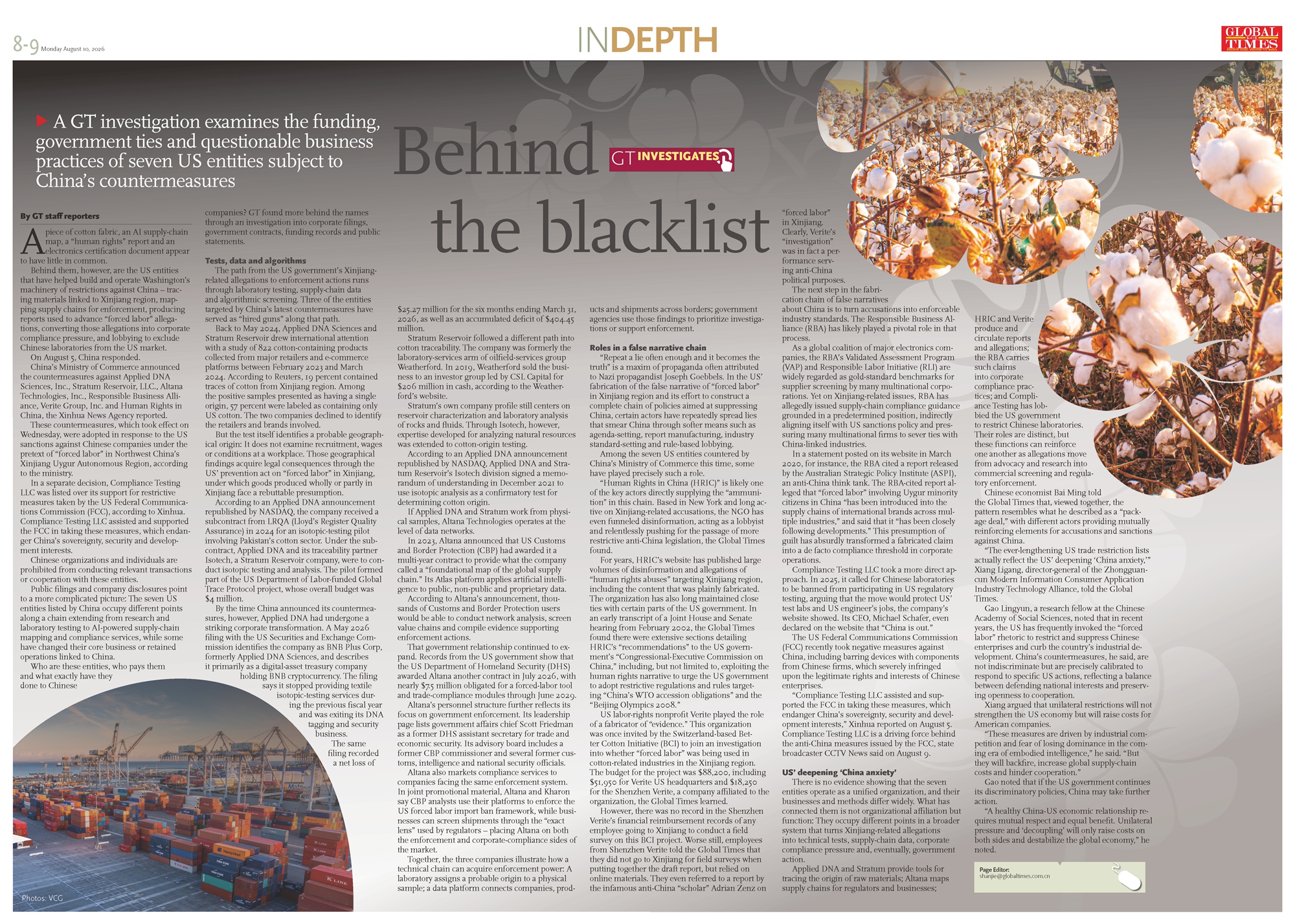
。 A piece of cotton fabric, an AI supply-chain map, a "human rights" report and an electronics certification document appear to have little in common.
Behind them, however, are the US entities that have helped build and operate Washington's machinery of restrictions against China - tracing materials linked to Xinjiang region, mapping supply chains for enforcement, producing reports used to advance "forced labor" allegations, converting those allegations into corporate compliance pressure, and lobbying to exclude Chinese laboratories from the US market.
On August 5, China responded.
China's Ministry of Commerce announced the countermeasures against Applied DNA Sciences, Inc., Stratum Reservoir, LLC., Altana Technologies, Inc., Responsible Business Alliance, Verite Group, Inc. and Human Rights in China, the Xinhua News Agency reported.
These countermeasures, which took effect on Wednesday, were adopted in response to the US sanctions against Chinese companies under the pretext of "forced labor" in Northwest China's Xinjiang Uygur Autonomous Region, according to the ministry.
In a separate decision, Compliance Testing LLC was listed over its support for restrictive measures taken by the US Federal Communications Commission (FCC), according to Xinhua. Compliance Testing LLC assisted and supported the FCC in taking these measures, which endanger China's sovereignty, security and development interests.
Chinese organizations and individuals are prohibited from conducting relevant transactions or cooperation with these entities.
Public filings and company disclosures point to a more complicated picture: The seven US entities listed by China occupy different points along a chain extending from research and laboratory testing to AI-powered supply-chain mapping and compliance services, while some have changed their core business or retained operations linked to China.
Who are these entities, who pays them and what exactly have they done to Chinese companies? GT found more behind the names through an investigation into corporate filings, government contracts, funding records and public statements.

The path from the US government's Xinjiang-related allegations to enforcement actions runs through laboratory testing, supply-chain data and algorithmic screening. Three of the entities targeted by China's latest countermeasures have served as "hired guns" along that path.
Back to May 2024, Applied DNA Sciences and Stratum Reservoir drew international attention with a study of 822 cotton-containing products collected from major retailers and e-commerce platforms between February 2023 and March 2024. According to Reuters, 19 percent contained traces of cotton from Xinjiang region. Among the positive samples presented as having a single origin, 57 percent were labeled as containing only US cotton. The two companies declined to identify the retailers and brands involved.
But the test itself identifies a probable geographical origin: It does not examine recruitment, wages or conditions at a workplace. Those geographical findings acquire legal consequences through the US' prevention act on "forced labor" in Xinjiang, under which goods produced wholly or partly in Xinjiang face a rebuttable presumption.
According to an Applied DNA announcement republished by NASDAQ, the company received a subcontract from LRQA (Lloyd's Register Quality Assurance) in 2024 for an isotopic-testing pilot involving Pakistan's cotton sector. Under the subcontract, Applied DNA and its traceability partner Isotech, a Stratum Reservoir company, were to conduct isotopic testing and analysis. The pilot formed part of the US Department of Labor-funded Global Trace Protocol project, whose overall budget was $4 million.
By the time China announced its countermeasures, however, Applied DNA had undergone a striking corporate transformation. A May 2026 filing with the US Securities and Exchange Commission identifies the company as BNB Plus Corp, formerly Applied DNA Sciences, and describes it primarily as a digital-asset treasury company holding BNB cryptocurrency. The filing says it stopped providing textile isotopic-testing services during the previous fiscal year and was exiting its DNA tagging and security business.
The same filing recorded a net loss of $25.27 million for the six months ending March 31, 2026, as well as an accumulated deficit of $404.45 million.
Stratum Reservoir followed a different path into cotton traceability. The company was formerly the laboratory-services arm of oilfield-services group Weatherford. In 2019, Weatherford sold the business to an investor group led by CSL Capital for $206 million in cash, according to the Weatherford's website.
Stratum's own company profile still centers on reservoir characterization and laboratory analysis of rocks and fluids. Through Isotech, however, expertise developed for analyzing natural resources was extended to cotton-origin testing.
According to an Applied DNA announcement republished by NASDAQ, Applied DNA and Stratum Reservoir's Isotech division signed a memorandum of understanding in December 2021 to use isotopic analysis as a confirmatory test for determining cotton origin.
If Applied DNA and Stratum work from physical samples, Altana Technologies operates at the level of data networks.
In 2023, Altana announced that US Customs and Border Protection (CBP) had awarded it a multi-year contract to provide what the company called a "foundational map of the global supply chain." Its Atlas platform applies artificial intelligence to public, non-public and proprietary data.
According to Altana's announcement, thousands of Customs and Border Protection users would be able to conduct network analysis, screen value chains and compile evidence supporting enforcement actions.
That government relationship continued to expand. Records from the US government show that the US Department of Homeland Security (DHS) awarded Altana another contract in July 2026, with nearly $7.5 million obligated for a forced-labor tool and trade-compliance modules through June 2029.
Altana's personnel structure further reflects its focus on government enforcement. Its leadership page lists government affairs chief Scott Friedman as a former DHS assistant secretary for trade and economic security. Its advisory board includes a former CBP commissioner and several former customs, intelligence and national security officials.
Altana also markets compliance services to companies facing the same enforcement system. In joint promotional material, Altana and Kharon say CBP analysts use their platforms to enforce the US forced labor import ban framework, while businesses can screen shipments through the "exact lens" used by regulators - placing Altana on both the enforcement and corporate-compliance sides of the market.
Together, the three companies illustrate how a technical chain can acquire enforcement power: A laboratory assigns a probable origin to a physical sample; a data platform connects companies, products and shipments across borders; government agencies use those findings to prioritize investigations or support enforcement.
Roles in a false narrative chain
"Repeat a lie often enough and it becomes the truth" is a maxim of propaganda often attributed to Nazi propagandist Joseph Goebbels. In the US' fabrication of the false narrative of "forced labor" in Xinjiang region and its effort to construct a complete chain of policies aimed at suppressing China, certain actors have repeatedly spread lies that smear China through softer means such as agenda-setting, report manufacturing, industry standard-setting and rule-based lobbying.
Among the seven US entities countered by China's Ministry of Commerce this time, some have played precisely such a role.
"Human Rights in China (HRIC)" is likely one of the key actors directly supplying the "ammunition" in this chain. Based in New York and long active on Xinjiang-related accusations, the NGO has even funneled disinformation, acting as a lobbyist and relentlessly pushing for the passage of more restrictive anti-China legislation, the Global Times found.
For years, HRIC's website has published large volumes of disinformation and allegations of "human rights abuses" targeting Xinjiang region, including the content that was plainly fabricated. The organization has also long maintained close ties with certain parts of the US government. In an early transcript of a Joint House and Senate hearing from February 2002, the Global Times found there were extensive sections detailing HRIC's "recommendations" to the US government's "Congressional-Executive Commission on China," including, but not limited to, exploiting the human rights narrative to urge the US government to adopt restrictive regulations and rules targeting "China's WTO accession obligations" and the "Beijing Olympics 2008."
US labor-rights nonprofit Verite played the role of a fabricator of "evidence." This organization was once invited by the Switzerland-based Better Cotton Initiative (BCI) to join an investigation into whether "forced labor" was being used in cotton-related industries in the Xinjiang region. The budget for the project was $88,200, including $51,950 for Verite US headquarters and $18,250 for the Shenzhen Verite, a company affiliated to the organization, the Global Times learned.
However, there was no record in the Shenzhen Verite's financial reimbursement records of any employee going to Xinjiang to conduct a field survey on this BCI project. Worse still, employees from Shenzhen Verite told the Global Times that they did not go to Xinjiang for field surveys when putting together the draft report, but relied on online materials. They even referred to a report by the infamous anti-China "scholar" Adrian Zenz on "forced labor" in Xinjiang. Clearly, Verite's "investigation" was in fact a performance serving anti-China political purposes.
The next step in the fabrication chain of false narratives about China is to turn accusations into enforceable industry standards. The Responsible Business Alliance (RBA) has likely played a pivotal role in that process.
As a global coalition of major electronics companies, the RBA's Validated Assessment Program (VAP) and Responsible Labor Initiative (RLI) are widely regarded as gold-standard benchmarks for supplier screening by many multinational corporations. Yet on Xinjiang-related issues, RBA has allegedly issued supply-chain compliance guidance grounded in a predetermined position, indirectly aligning itself with US sanctions policy and pressuring many multinational firms to sever ties with China-linked industries.
Compliance Testing LLC took a more direct approach. In 2025, it called for Chinese laboratories to be banned from participating in US regulatory testing, arguing that the move would protect US' test labs and US engineer's jobs, the company's website showed. Its CEO, Michael Schafer, even declared on the website that "China is out."
The US Federal Communications Commission (FCC) recently took negative measures against China, including barring devices with components from Chinese firms, which severely infringed upon the legitimate rights and interests of Chinese enterprises.
"Compliance Testing LLC assisted and supported the FCC in taking these measures, which endanger China's sovereignty, security and development interests," Xinhua reported on August 5. Compliance Testing LLC is a driving force behind the anti-China measures issued by the FCC, state broadcaster CCTV News said on August 9.
US' deepening 'China anxiety'
There is no evidence showing that the seven entities operate as a unified organization, and their businesses and methods differ widely. What has connected them is not organizational affiliation but function: They occupy different points in a broader system that turns Xinjiang-related allegations into technical tests, supply-chain data, corporate compliance pressure and, eventually, government action.
Applied DNA and Stratum provide tools for tracing the origin of raw materials; Altana maps supply chains for regulators and businesses; HRIC and Verite produce and circulate reports and allegations; the RBA carries such claims into corporate compliance practices; and Compliance Testing has lobbied the US government to restrict Chinese laboratories. Their roles are distinct, but these functions can reinforce one another as allegations move from advocacy and research into commercial screening and regulatory enforcement.
Chinese economist Bai Ming told the Global Times that, viewed together, the pattern resembles what he described as a "package deal," with different actors providing mutually reinforcing elements for accusations and sanctions against China.
"The ever-lengthening US trade restriction lists actually reflect the US' deepening 'China anxiety,'" Xiang Ligang, director-general of the Zhongguancun Modern Information Consumer Application Industry Technology Alliance, told the Global Times.
Gao Lingyun, a research fellow at the Chinese Academy of Social Sciences, noted that in recent years, the US has frequently invoked the "forced labor" rhetoric to restrict and suppress Chinese enterprises and curb the country's industrial development. China's countermeasures, he said, are not indiscriminate but are precisely calibrated to respond to specific US actions, reflecting a balance between defending national interests and preserving openness to cooperation.
Xiang argued that unilateral restrictions will not strengthen the US economy but will raise costs for American companies.
"These measures are driven by industrial competition and fear of losing dominance in the coming era of embodied intelligence," he said. "But they will backfire, increase global supply-chain costs and hinder cooperation."
Gao noted that if the US government continues its discriminatory policies, China may take further action.
"A healthy China-US economic relationship requires mutual respect and equal benefit. Unilateral pressure and 'decoupling' will only raise costs on both sides and destabilize the global economy," he noted.
。
Current article:http://a543p9.minshixuanhabing.bond/hk7/kzx3jo.html
Published on:16:35:14
 杭州体育发展“十五五”规划发布
 恒立液压:上半年归母净利润14.36亿元,同比增长0.50%
 China's economy holds steady in first seven months
 迅雷官方分析:为什么下载速度慢/卡99%/电脑卡?
 曝《GTA6》昼夜循环足有144分钟!是前作的3倍
 老後の年金、額面いくらなら「非課税」になる?ギリギリ課税世帯になると保険料負担はどうなる?
 37天两遇台风,记者再访友谊村——安置点人少了,重建房屋地基加高了
 插混动力/综合续航1360km 定价是关键!一文看懂新款沃尔沃XC60
 森林狼全队埃菲尔铁塔前合影:戈贝尔站C位 爱德华兹三球并肩靠边站
 강원도 산업용 전기요금 8% 인하…정부·한전 지역 요금제 공개
 경산서 실종 中유학생 살해 피의자, 여장한 채 동대구역까지 이동
 国安部披露一起泄密事件